Thursday, January 31, 2008

Easier to go from Zero to Great than from Good to Great!

After a very jam-packed week, I took the chance to rest up today in an effort to knock the edge of a couple of injuries sustained over the past four or five days. I rarely ‘completely rest’, as there are always e-mails and other admin duties to attend to; but it was a pretty easy day, nevertheless. I video-chatted my friend Dave Meyer in the states, who has also been under the pump of late. We were discussing work and time management issues and he made an interesting comment. He told me that I had offered up this idea some time ago – but I cannot recall doing so, and suspect it’s a Dave Meyer original.
The idea is that it is harder to go from Good to Great than it is to go from Zero to Great. And the reason is simple: when things are going along nicely, our lives tend to become ‘full’ – full of good things and good work, good friends, etc. This though, comes with it’s own set of problems – we then become loathe to ‘give up’ any of these ‘good things’, and without doing so, leave little room left to bring the truly ‘great things’ into our lives. Conversely, when we are at ‘zero’, we have nothing but time and opportunity before us, and can try new things, take new chances, etc.
It’s like being on a rock-climb and finding a perfect hold – it’s nice to have that hold, it makes us feel strong and secure – but along with it comes the problem of not wanting to give it up to make further progress.
This is an interesting thought – and may explain hwy so many of us reach a place where inertia seems to take over. We lose that ‘eye of the tiger’ – so desperate we are to hold onto the good things we have.
In my personal situation, I have on occasion missed out on potentially great opportunities because the ‘good’ opportunities wer consuming so much of my time. I wanted to share this with my readership as I suspect that I am not the only victim of this subtle trap. It makes for an interesting thought for the day – at the least ….
JBW

Wednesday, January 30, 2008

Another Day at the Office!

A little crazyness is good for the soul; and so begins, another day at the office. Let the games begin …
JBW

Monday, January 28, 2008

Biting the Bullet

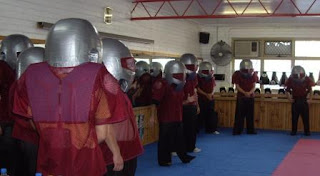
Well, after the past week, it's nice to have a breather for a day. What a week it was. The last two days of it was allocated to Adrenal Stress Conditioning; something that most martial artists don't train - or even consider. This is definitely a facet of training that everyone should experience. When people see pics or video footage of this training, they tend to focus on the unique Bulletman Suits - as we are all wearing in the pic here - and so are inclined to make snap judgements as to what the training is all about. But there is much more to it than wearing the suit and taking a pounding from the student. There are 'Boundary-setting' excerises, where the pressure is gradually ramped up and the students are taught to maintain their personal space and come back with appropriate and assertive response rather than a passive response (which gives the aggressor what he wants) or an overly aggressive response (which may well kick the confrontation into the realm of the physical). This is more difficult that it sounds. Only after students learn to successfully manage the effects of the adrenal rush they experience in this part of the training, are they exposed to the actual physical part where things are ramped up even further, and the Bulletman comes into action. Often it is the highly trained fighters that have the greatest difficulty in breaking contact with the aggressor, even after he has gone down - to the point where they are not aware of what's happenning behind and around them (so over-focussed as they are on the opponent) - although this is an asset in one-on-one competition - it is a huge and potentially deadly liability in a survival situation.
So those aspects and others were what was experienced by the students - on the instructor training side of things it was much more complex. There is the coaching role (guardian angel that talks the student through each altercation) - the Bulletman role - how to take the shots and be a good aggressor - and the woofer role - how to take on board various characters and understand how to elicit the right response from the student in the different scenarios.
Without going into detail - I have to say it was an enlightening, entertaining, fun and sweat-filled two days of training. It's something we all will do more of. Thanks to all who were a part of the experience - and a special thanks to Debra and Bill Kipp, who came all the way from Colorado t make it happen.
JBW

Sunday, January 27, 2008

Melissa Will adrenal response

This past week has been a big one. The last few days a group of ten instructors underwent some intensive scenario-based Adrenal Stress Response training with Bill Kipp from the states. Bill isa friend of mine who just happens to be (in my considered opinion) the best in the world at this particular facet of training. More later - but for now, a small clip of my wife Melissa under the pump ...
JBW

Sunday, January 20, 2008

Man Down ...

Martial arts training and injuries go ‘hand in hand’. With one, comes the other. It’s just part of it. Hopefully through the use of smart and safe training practises, we can reduce the amount of annoying injuries to a minimum and the amount of serious injuries to zero. But with contact comes risk!
The more classes you do – the more the chance of injury increases. If you do classes a week, you may get through a year with no injuris whatsoever. If you do twenty-five classes a week, you will almost certainly sustain injuries throughout the year. As a professional, I am almost permanently injured. The fact that I teach somewhere between 25 and 30 classes in any week means that not only am I receiving injuries, but I rarely enjoy access to recover time. I’m okay with this – a little frustrated at times perhaps – but I do accept that this is what I do. The older you get, the longer it takes to recover. As a twenty year old, I’d recover from a sprain or strain within days – now, as a 50 year old, it takes longer. I have had four knee surgeries and one elbow surgery over the years, and mostly because I have been in reasonable shape before I hit the operating theatre, I recovered rapidly and was back on the mat within ten days or so each time. So there are many factors that come into how well we recover from injuries. The advice I most often give to people is the same advice I give to (and take) myself:
KEEP TRAINING! Find a way to work around the injury – this will keep you mentally IN THE GAME – and keep the rest of you in shape. One of the biggest drama’s with injuries is when we completely stop what we do because of an injury and the rest of our body-system begins to decline as a result. It is this collateral/secondary impact that can usually be completely avoided. My rule is simple – DON’T MAKE THE INJURY WORSE WHILST FINDING A WAY TO KEEP TRAINING!

Be well – train safe – train smart – and keep doing it.
JBW

Wednesday, January 16, 2008

Taking it to the ground

I am often asked, (in fact I was asked this very morning) when is the best time for a student to start learning takedowns. There are two answers: pick whichever you like best ….
From a training-design perspective, I believe that it’s no use learning to take someone down unless you are already proficient on the ground. Why go down unless you are fairly certain, that in doing so, you have significantly increased your chances of a favourable outcome. So generally – I don’t expose students to takedowns until they are a BJJ Blue belt level.

Having said that though, if you have the time (or the student has the time) – then learn all you can whenever you can – and then arrange things as they should be at a later date. In fact, although there is a THEORETICAL order in which we should learn things – we rarely follow this order as we should. We learn when the opportunity presents itself – and we apply the lesson learned at some time when circumstances or skill levels permit. Human beings are opportunistic learners at their core. It’s hard to stop them from uncovering secrets – as anyone with kids will attest to.

So from a CURRICULUM DESIGN perspective, I wouldn’t teach takedowns before GROUND COMPETENCE. But from a training perspective – grab the sills whenever you can – but be prepared to modify and adjust when the context becomes clearer and more complete when you are more skilled. It is a never-ending process.

Best wishes,
JBW

Tuesday, January 15, 2008

My Friends Lift Me Up ...

When I am asked what the best thing about my martial arts life is - I always answer the same way: ‘the friendships I have made’. I have managed, over the years, to form some great friendships; but I have to admit, I have become more selective about who I ‘hang out’ with as I have become older. Sure, I'll be nice and polite enough to people who have lots of negative stuff going on despite the fact that they seem keen to share it with me - but I don’t develop close friendships with those types of people. Seriously - LIFE IS JUST TOO SHORT - I've become kind of fussy I guess. It is amazing to me (perhaps I am just beginning to take more notice) how many people there are that actually resent success and resent other people moving forward - perhaps it makes them realize that they themselves are not achieving the things they set out to achieve. One way to maintain thr 'shoulder to shoulder' position in a race, is to hold the other guy back. It’s not so much that I am repelled by such people - it’s this - I AM SIMPLY MORE ATTRACTED TO PEOPLE WHO ARE POSITIVE, HAPPY AND GENUINELY PLEASED WHEN OTHERS DO WELL - and so I have naturally and gradually surrounded myself with those sorts of friends. When my friends do well,achieve goals, buy themselves a new car, house, or whatever - I can honestly say that I am genuinely overjoyed for them. I applaud their success - not just outwardly, but within myself also. None of us can achieve anything without the help and assistance of others. Even a lone assault on the south pole needs a huge support team.

Which brings me to say a big THANK YOU to my webguy who is responsible for the upkeep, mainatanence and ever-improving look of my web-related stuff: GEOFF GRANT. Nothing has been too much trouble for Geoff over the years. He has always selflessly tried to do whatever he can to help me out with in this area of my life. I of course, shall continue to do my best to do the same for him (I feel I have the better end of the deal). Geoff, who recently achieved his BJJ Black Belt, is a wonderful guy. he is probably embarrased by this blog - but I think it’s important to tell friends how important they are. Thanks Geoff - all your help is not only appreciated - it is NEVER taken for granted.

I have other friends who have congratulated me about the publishing of my new ROGUE BLACK BELT book series - they have taken the time to recommend my books to their friends and gone out of their way to send me e-mails and letters in way of congratualtions. No-one realises how much this means to me. I thanks all of you - you know who you are! I hope I can always reciprocate.

What does it cost, to genuinely wish others well? Virtually nothing - and yet in doing so, we begin to re-wire our own thinking, our own view of the world.

Regards,

JBW

Monday, January 14, 2008

Predator or prey - how do we play?

The natural world is rife with play. Interestingly, it has been shown that the way that animals engage in play, is a direct reflection of the roles they play in the predator/prey relationship. For example, lions engage in a type of play that teaches them how to run down another animal and wrestle it to the ground; whereas, at the other end of the spectrum, the young antelope engage in play that build s evasive skills, which later in life will help them avoid being chased and killed by the lions. It seems that most animals play in a way that prepares them best for the rigors of natural existence. Are we, as humans, any different?
Grappling is a version of rough-play that can prepare us for struggle in the complicated and highly competitive world we live in. To know and understand struggle, leverage, defeat, domination, fear, courage, experimentation - is to arm ourselves for the living of life. In our lives we all wear the masks of both predator and prey. I don't mean this in a negative sense - but in it's purest sense. Think on how you play - play well - and play often.
JBW

Thursday, January 10, 2008

Check your excuses at the door!

Not feeling like training today? I am keen to hear the excuse? Take a look at this quick vid-clip and then come with the excuses ...

Wednesday, January 09, 2008

Rome wasn't built in a day

I have to say - from a coach's point of view, I place far more stock in persistence and determination than I do in athletic ability. Some of the most succesfull people I know (in all sorts of fields) were not the 'most likely to succeed' or 'most gifted' of their peers - but one thing they all share in common is 'consistency'. As my coach Rigan Machado used to say - a little each day is the key to success. I have seen numerous gifted althete's come and go, but it's the ones who stick at it - with steady conviction, that ultimately get the best results. One such student, Neil Fitzsimmons of Geelong, did just that; and received his BJJ Black Belt last evening. Congratulations Neil - I flicked open my dictionary last night to look up the word CONSISTENT - and there was a picture of you! Well done!
JBW

Monday, January 07, 2008

Footprints in the Brain

Every time we hear a story we havn’t heard before, as we see it in our mind’s eye, we change forever, who we are. New stories and their accompanying images, leave ‘footprints’ in the landscape of our neurology. This is why ‘story-telling’ is such an important part of the teaching process. Ultimately, teaching is an effort to permanently change our neurology; to permanently change who we are. Each and every day we are changed in innumerable ways; this is simply fact. So we might as well try to direct and orchestrate some of those changes in ways that are beneficial to us. We are the sum of our thoughts; those thoughts can be generated from within or be stimulated from without. We have control over both. In exercising that control, we can direct some of those footprints that that leave their mark through the ever-changing landscape of our mind.
My advice? Read! The read some more. Reading is a habit. A good one, A life changing one. read just 12 inspiring and thought-provoking books a year and break away from the pack. Reading expands your mind and re-defines who you are. The footprints that remain in the landscapes of our mind after reading a good book, will be there forever, and can have a positive and lating impact on how we live and act in the world. Get a book - get to some reading. Start today!
JBW

Friday, January 04, 2008

Fun ...

Am here in Singapore with my family for a few days holiday before class starts back next monday. I couldn't help myself, and took a class fr friend Kon Quek last nifght, their first for 2008! At the end of the class, at question time, oe student asked how to overcome 'an over-reliance on fighting with strength' - I offered up the idea that he was entirely in control of how hard and at what pace he fights. As long as we are 'prepared to tap', we can fitht at any pace we choose; we can fight at a pace that allows us to fight all day; or we can fight at a pace that will see us run out of gas within minutes, or less. The pace, the amount of strength and agression we use, are things that are totally in our control. For me, it all comes down to having fun.

Training is fun. And so it should be. Keeping it fun, means that we will keep doing it. If we are consistent in training, eventually, even without talent, we become competent. Keeping it fun means that we will try new things, experiment, etc. This in turn will keep us on a path of discovery. Discovering new things and ideas, can be a joyful experience in itself. And so the process of having fun and experiencing joy can begin to develop a momentum all of it’s own.

On the mat though, we can often meet people who seem to have a different concept of fun than we do. I am okay with that. Other people are not responsible for my fun. Overly competitive people abound in the martial arts environment; pretty natural really, after all, we are talking about inter-personal combat. And that’s okay with me. Just make the competition fun. It’s all about attitude – our attitude. We can’t control the way other people think; we can control and adjust the way we look at things ourselves. Decide to enjoy every bit of the training experience. Decide to have fun.
JBW