Sunday, March 30, 2008

Best Investment ....

For those who have ever used the services of a financial advisor, you will no doubt have been told that the important steps to financial independence are: pay of credit card debt - start putting a little into superannuation (401K for USA readers), pay of your mortgage if you have one, then really start pumping funds into 'super' or other retirement fund - and bingo, you are on your way to living a financially independent existence. Although I do agree with some of this - I am always wary of taking advice from people who are working long hours in jobs that takes them away from the things they would rather be doing.
Advisors are always talking about this or that 'investment medium' - citing that the most important thing is to 'save for retirement' - and although it is important to put money away, I strongly disagree with much of their philosophy. For me, the single most important investment medium - is MYSELF!
Investing in ourselves, our health, our happiness and our ability to produce income is by far the best investment we could make. If we love what we do; and we are healthy and happy, we can earn money that will allow us to do and have the things we need. Putting our main focus on saving for retirement can distract us from 'living now' - from 'earning now' and from honing and improving our 'earning potential'.
YOU are the best investment you could ever make. Invest in your own continuing education, in your health, your happiness - and money will not be a problem.
Here's to good health and investing in yourself.
Warm regards,
JBW

Friday, March 28, 2008

Dumbing down our kids ...

I have recently received a couple of e-mails from people who have informed me that the points made in the post before last - "I love these Bill gates lecture points' - did not originate from Bill gates himself. I havn't had time to verify this as yet - a busy day - but more than one person has let me know that they originated from the work of Charles J Sykes - author of the book: "Dumbing Down Our Kids - Why American children feel good about themselves but can't read, write or add.
I myself have no opinion one way or another on these claims - as I havn't had the time to chase it all down. But if Mr Sykes was the original author - then certainly the kudos should go to him. If anyone is interested - I suggest you 'google' - Charles Sykes and perhaps even get a hold of his book. Gotta run - actual work to do.
JBW

Thursday, March 27, 2008

ACTION!

When I think martial arts - I think ACTION!
The way of the martial artist - is the way of action. The DOING is the most important thing about martial arts training. Whether you train in Tai Chi, or whether you are a hard-core MMA Fighter, it's the DOING that counts.
In life off the mat, the DOING, the ACTION is also a critical ingredient to success. I have known many people, and I include myself among them, who at one time or another, knew enough to 'make a move', or to 'do something' but could simply not go the next vital step - and pull the trigger.
"Hey, I could have written that book' - I've actually heard this. I was polite enough to keep my thoughts to myself - but those thoughts were, 'Perhaps your right, you could have done it. But you DIDN'T!' There's knowing, and then there's PULLING THE TRIGGER. Actually doing it. Taking action. Thoughts don't create much - in and of themselves. We can wish and hope and think all we want - and the universe will ignore us. It's only when we take action that things start to happen.
As I am fond of saying - you can stick the motivational poster up on the wall - and 'put the thought out there in the universe' - you can even light up some incense - and put on some nice music - but nothing will happen. Well, not entirely true - something will manifest - a family of spiders will eventually take up residence behind the poster. The poster is there for one reason only - to inspire you into taking action. Take action today - make things happen.
Best regards,
JBW

Tuesday, March 25, 2008

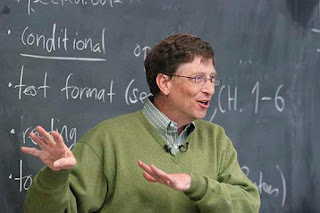
I love these BILL GATE'S Lecture Points:

BILL GATES LECTURE POINTS:

FEEL-GOOD, POLITICALLY CORRECT TEACHINGS HAVE CREATED A GENERATION OF KIDS WITH NO CONCEPT OF REALITY.

ELEVEN THINGS YOU NEED TO KNOW

1. Life is not fair – get used to it.
2. The world won’t care about your self-esteem.. The world will expect you to accomplish something BEFORE you feel good about yourself.
3. You will not make $60,000 a year right out of high school. You won’t be vice-president with a car phone until you earn both.
4. If you think your teacher is tough, wait till you get a boss.
5. Flipping hamburgers is not beneath your dignity. Your grandparents had a different word for flipping hamburgers: they called it opportunity.
6. If you mess up, it’s not your parents fault, so don’t whine about your mistakes, learn from them.
7. Before you were born, your parents wern’t as boring as they are now. They got that way from paying your bills, cleaning your clothes and listening to how cool you thought you were. So before you save the rain forests from the parasites of your parents generation, try delousing the closet in your own room.
8. Your school may have done away with winners and losers, but life HAS NOT. In some schools, they have abolished failing grades and they give you as many times as you want to get the right answer. This does not bear the slightest resemblance to ANYTHING in real life.
9. Life is not divided into semesters. You don’t get summer off and very few employers are interested in helping you FIND YOURSELF. Do that on your own time.
10. Television is NOT real life. In real life, people actually have to leave the coffee shop and go to jobs.
11. Be nice to nerds. Chances are you will end up working for one.


IF YOU CAN READ THIS, THANK A TEACHER. IF YOU CAN READ THIS IN ENGLISH – THANK A SOLDIER!

Monday, March 24, 2008

Developing a SMART Training Culture

The important thing to understand here is that if the whole school has a SMART CULTURE – and it is comprised of people working together, then it is hard to go wrong. Further to my last blog, here are some further considerations that may impact on how much we get out of our training.

- work a technique in it’s proper progression – and by that I mean start working it under ideal conditions (perfect storm concept). Then once you have a good feeling for the technique and can apply it automatically (under ideal conditions) – begin to add problems in – ONE AT A TIME. Do this progressively by starting with a slight deviation from the ‘perfect set of circumstances’ – eventually, evolving to being able to ‘MAKE THE TECHNIQUE HAPPEN’ even though the conditions/circumstances are far from ideal. For this you need good partners.
- Slowly begin to develop combinations that are based on the opponents reactions to our attempts at given techniques. Try the technique – see how our opponents react to it, then come up with ways to capitalize on these reactions. Do this as a project – one technique at a time – it’s a lifetime of work, and fun. But again, it requires a roomful of partners.
- Develop a TECHNICAL MINDSET. There is no such thing as ‘too technical’. Being technical comes from the development of a ‘state of excellence’. We should be mindful of always trying to deepen our understanding of every technique we do. How does it work – why does it work – what are the various components of the move – where are the best points of leverage – how do the mechanics of the move effect our opponent and what is the sequence of their unfolding? These are all good questions that we should be able to answer if we fully understand the given technique. Developing this ability takes practice – technical thinking is a habit – become good at it. I like to create a technical environment in my school – that way the whole school tends to cultivate this type of thinking.
- Be OBSERVANT. It is crucial that we all become very observant. Mindfully catalogue what happens when we do certain things. Learn to recognize patterns. It is how we make sense of the world.
- DIFFERENT OPPONENTS REQUIRE DIFFERENT SOLUTIONS. This is important to realise. Unless you can dominate all of your opponents in the way and fashion of your choosing (because you are far bigger and more technical) then you almost always need to change the way you fight different people. Sometimes you need to crush – sometimes you need to move – sometimes you need to be soft and sometimes, forceful. This variety is what makes the game fun.
- CHOOSE THE RIGHT SCHOOL. You may not have a choice is this – but if you can, do some research, Who is your coach – where does he get his training from – and perhaps even more importantly, what does his school FEEL like. What’s the atmosphere like. Is it full of smiling students who are looking after each other and having fun? If so, it shouldn’t come as a surprise that may of them are skilled. If the school has only a handful of scowling fighters – steer clear – your in the wrong place.

I hope these points help – best wishes,
JBW

Thursday, March 20, 2008

So what is SMART Training?

Quite a few people have e-mailed and asked me to elaborate on what I mean by SMART training. Obviously, this is a difficult question to answer in one or even several blogs – but I’ll try to offer a few pertinent points here now:

- Get your foundation/Basics squared away before you get too deep into ‘personal game’ development. Be an all-rounder first – know something about every position before you start to learn everything there is about any one position.
- Don’t ‘Fight/compete every time you wrestle. Make sure to spend a lot of time ‘playing jiu jitsu’ – this way you will try new things, experiment, turn left where you have usually turned right and thereby make discoveries.
- Follow a syllabus. By following a good syllabus, you will ensure that you are always covering a healthy and balanced cross-spectrum of techniques and strategies – and not become too narrow-focussed or irrelevant.
- If possible, keep your training session to an hour or so – and do that two to three times a week. Regular smaller training sessions through the week are a far better way to go than a single huge session on the weekend.
- Have at least one great training partner, with whom you have made an arrangement to work and experiment with. Everyone needs a partner with whom they can say ‘freeze – let me work this problem’. Good training partners are hard to come by – so when you get one, spend plenty of time helping them with their problems and ‘sticking points’. You and your training partner will form a ‘team of two’. This is vital.
- Once you have a solid foundation – (A Blue belt level should reflect this ideal) then it’s time to start working on your ‘personal game’. This should be a game that focuses on using your technical strengths. When you start out developing your personal game, you need to (at bare minimum) develop game-plans that will address at least three areas: PASSING – SWEEPING or ATTACKING from the Guard – and FINISHING from the top somewhere (mount, side control, etc)
- As a very rough guide – try working each of the above game-plans for a month or two at a time. Ie: Focus on Guard passing for a month – then focus on your sweeping, then focus on your favourite finish. This ‘month per technique’ can be stretched out to two or even three months per technique if you have the mental focus and discipline to do so. You are guaranteed to make huge gains.
- Treat injuries with respect. Yours and others. If your train every day, you can expect to be carrying some sort of injury, most of the time. Pro rugby players are almost always injured – and if you train every day, you can expect to be having to deal with some nagging injury on a regular basis. It’s okay if you are smart about rehab and sensible with your grappling. I prefer to get on the mat when I am injured and take the opportunity to work on some other aspect of my game/training. I choose not to ‘take two weeks off’ – as would be prescribed by the local GP. Partly though, because this is my profession – I need to be on the mat. Even so, don’t stop training for a month because you have sprained your little toe – strap it up and get back in there.

Well, I hope that some of these points will help you to better understand what I mean by Training Smart.
Best wishes,
JBW

Wednesday, March 19, 2008

You either ARE good – you GET good – or you give up!

Now, admittedly there are many shades of grey – but it has been said that those who start out on the road to learning a new skill, fall into three categories: They either ARE good, they GET good or the GIVE UP! That is:

1. They have natural ability and ARE just good to go, from the very outset.
2. They start out with little or no natural ability, but through work and perseverance, they become skilled.
3. They don’t like the pace (or lack thereof) of their progress, and they give up.

From my perspective, as both a coach and a martial artist who had to work hard for everything I have gained, I place little or no value on natural ability. In fact, I have seen countless ‘naturals’ come and go – very few remain for the long haul – they quite often move onto the next challenge, before they have gone the distance with the first. As far as those who fall into the ‘Give Up’ category, I am saddened by the fact that such people don’t seem to realise that anything worth having is worth fighting for in the first place. But again, I can’t do much with anyone who ‘gives up’ before I can ‘train them up’. My focus and interest lies with the middle group – people with little or no natural ability, but who are willing to ‘stay the course’ and become skilled over time. I have seen countless ‘ordinary’ people achieve extraordinary things through perseverance and consistent training. Most people are ‘highly trainable’ and the key is CONSISTENCY. Well, consistently SMART training, I should say. I have also seen countless people who are (sadly) training hard – but training the wrong way, or in a way that in so inefficient, that they take eight or ten years to achieve what a smart approach would have allowed them to achieve in only two or three years. In fact, nowadays, a fair amount of my work is spent ‘undoing’ the effects of incorrect and inefficient training. Taking a smart approach to training and doing a little every day – will eventually make almost anyone – an expert.
Train well – train smart - train often.
JBW

Sunday, March 16, 2008

Seeking Rabbit droppings ...

With Easter nearly upon us, I thought it appropriate to offer up a 'bunny-based' idea. The title may be a little strange, but if it gets the message across – I’ve done my job.
Want to get more ‘omoplata’s’ – looking for more armbars – after more sweeps? Then don’t look for the technique itself – instead, look for the ‘overhook’, the ‘underhook’, or whatever it is that will ‘lead’ you to the sweep, the armbar or the omoplata.. When you are hunting rabbits, you don’t start looking for rabbit’s, you first look for rabbit droppings. There are more ‘rabbit droppings’ than there are rabbit’s, just as there are more overhooks to be found than ‘omoplata’s’. First you find the ‘overhook’, then you get the ‘omoplata’. First you need the underhook, then you get the ‘half-guard’ sweep. You get the idea. Identify the thing that will lead you to the technique, this way, you will start seeing the move earlier and be ‘hunting’ for it, rather than waiting for it to organically ‘pop up’ – which it may do, but only every now and then. We find more of what we are looking for by looking for the signposts that tell us we are close. There are always more signposts than destinations. Keep a look out.
Good training,
JBW

Wednesday, March 12, 2008

Wherever you go - there you are!

The one thing we always take with us wherever we go - is ourselves. There is simply no escaping it. I actually know people who don't like themselves very much - I could not imagine a worse way to live life. I like my own company, am amused by my own thoughts and can very happily spend lots of time alone - in fact, it is very important for me (and perhaps others) that I do so. I am always happy to spend money on my own education and furtherment (is that even a word?) But you know what I mean; I will spend money on travel, on training, on books, on bringing other people that have something to offer, to me, when I do not have the time to go to them; all such things, in my experience, have returned far more than they have cost.
Each of us should be aware that the single most important asset we have, is ourselves. It's weird to me that people spend plenty of time looking after their cars, their investments, etc - but not too much time on themselves. It's good to be a little selfish - it allows us to be generous.
Nosce te ipsum - as the latin goes: Know thyself
- JBW

Wednesday, March 05, 2008

NZ Friends

In a few more days I leave for a round of teaching in New Zealand. NZ is one of my favourite places - great people, great country! I love the enthusiasm with which the students there leap into their training. My Kiwi friends are a passionate bunch.
The road to mastery is a long one - and along the way, our levels of motivation can rise and drop as life and other stuff gets in the way. 'Passion' though, is a powerful fuel, and can drive us forward with enough momentum that even during tough times, we continue to move toward the golas we have set for ourselves. "passion' is closely associated with the 'toward' style of motivation - as opposed to the 'away from' style of motivation. I like the 'toward' style - it is more consistent and sustainable. The 'away from' style ( Eg: I want to be less like i am now) starts to wane and wither, the further we move away from our present state - and if, as it does so, we fail to replace it with something else, we lose our momentum and begin the 'backward slide'. The 'toward' style of motivation however, only strengthens as we move forward and get closer to our goals - passionate people exude this quality.
My next few days are busy here with my usual weekly round of teaching, both private classes and the evening classes at my school; then I'll be packing on thursday night and jumping on the early morning flight friday morning to the land of the long white cloud. See you soon my Kiwi friends.
Warm regards,
JBW

Monday, March 03, 2008

The Perfect Storm

The ‘perfect storm’ teaching model is one I frequently employ.
It goes like this: I introduce a technique by illustrating it in the best possible set of circumstances before trying to ‘make it happen’ in less favourable circumstances. Imagine a ladder – the bottom-rung represents the ‘perfect storm’, the situation is just perfect for the execution of the given technique. The next rung up the ladder is very slightly ‘less perfect’, so we need to change something a little bit, to get back to ‘the perfect set of circumstances’ situation. The next rung up represents a slightly more difficult situation, and so it goes, until the top rung of the ladder represents a situation in which the technique would not normally even be considered. By starting at the bottom rung when teaching the technique, the students get clarity on ‘the ideal’ and ‘where’ it is. That way, even if they are a few ‘rungs’ removed from that ideal, it may occur to them that they can still ‘make it happen’. It is my observation, that very often students are introduced to techniques on the third or fourth rung level – and this can be the reason why they find it difficult to ‘make things happen’ with any degree of consistency.
Usually I need a white-board and a marker pen to illustrate this concept clearly. I hope you get the idea.
Train smart,
JBW