Tuesday, January 31, 2012

Following on from my last blog – I will offer up one way to go about the design and construction of a game. Before I begin though – let’s remain clear on what I mean by the term ‘game’.

 A game is basically a ‘plan’ – that is; we go in with a definite and clear idea of what we want to achieve; rather than just rolling for fun and dealing with whatever situations arise (though that kind of rolling can also have great benefits). A plan should also be systematic and linear – by this I mean, we try to initiate and carry out our pre-determined plan (technique or string of techniques). If the opponent fails to come up with any effective strategies to thwart our plan – then we simply push on and execute it. If the opponent puts obstacles in our way – we (over time) come up with ways to overcome, remove or take advantage of these obstacles – and thereby ‘develop’ our game.

 We do all of this – ONE POSITION AT A TIME. IE: We develop a GUARD PLAN, a PASSING PLAN, a SIDE CONTROL PLAN, A MOUNT PLAN, etc. Again – all this takes time! You develop a plan ONE POSITION AT A TIME!

 There are many ways we can think about what this concept could look like as two dimensional image – it could be perhaps most accurately depicted by a systemic flow-chart (IE: we do this – if he responds this way, we do that – if he responds that way, we do this, ETC). The way though, that I like to think of it, is a little more conceptual and can be likened to the shape of a galaxy. The center is your basic plan – what you will do if there is little or no resistance – then as we spiral away from the center – we are adapting/developing our plan, according to our opponents reactions – as we keep spiralling away, the whole thing becomes a little tenuous as we are now dealing with highly exotic or unlikely reactions and are being taken further and further away from our CORE idea. One could keep working to overcome an opponent’s reactions to a basic plan – forever – but at some point I find it more useful (and interesting) to just go explore another galaxy. And start to develop a new plan – for a new position. I hope this helps – best wishes: JBW

Monday, January 30, 2012

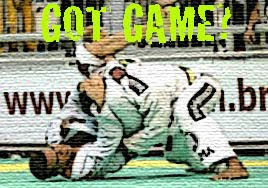
Got Game? Pt 1 …

There are many ways to approach the study and practice of martial arts – and there are also, many ways to approach the study of practice of even one specific martial art. BJJ has many faces. We can take it on as a lifestyle – a way of being, looking at or living, in the world. We can approach it as a problem (or infinitely evolving serious of problems) and reap joy and understanding from solving those puzzles. We can approach it as an athletic endeavor – a physical and mental challenge to urge us toward better fitness. We can take it on as a self-improvement vehicle; and through practice, gain better and deeper understanding of ourselves and others. We can take it on as a sport; providing us with an arena in which to compete against others … oh yes, and then there is the ‘self defence’ aspect to boot … As far as the sporting face in concerned; we need to build (over time and after we have established a solid foundation of basics) ourselves a ‘game’. Many people ask me these sorts of questions – ‘what is a game?’ – ‘what sort of game should I be working on?’ – ‘is there a best game?’, etc. Now even though this is a large topic (among many topics) – I’d like to offer my two cents worth on ‘game development’. Pre-blue belt – my opinion is that we should be learning and focusing on rounding out our understanding of the ‘fundamentals of BJJ’ – including, how best to deal with the more common ways that we can be assaulted (headlock defences, grab defences, etc). Once we have an understanding of the basic principles and techniques of BJJ, and have been rolling (grappling/wrestling) for some time to hone these techniques and instill them into muscle memory – we need to begin working on or developing our ‘game’. And remember, this ‘game’ will continually evolve and transform over time … and initially, will to a large degree be driven by what is happening on our mat. (eg: if everyone is standing up to initiate the guard pass – then back-sweep will become an important part of our game – if not, then it won’t – simple as that) But how to begin … ? Sorry – gotta run – time to hit my Monday morning workout … will continue in a day or two ….

Saturday, January 28, 2012

Leave your ego at the door

Ego can be a crippling thing.

Behind our ego lies a subtle intelligence; one, that, if sensing we are likely to fail at something, quietly offers up rationalisation for why we shouldn’t even try. It guarantees that we never fail by not letting us attempt in the first place.

Paying less attention to the voice of the ego is the first step in putting ourselves on a path to greater learning. When I became more and more content with being able to try and fail, I began to improve my ability to acquire new skills at an ever-increasing rate.

Children are the best example of effortless learning; and the reason they learn so quickly and without apparent effort is because they are simply more okay with failure than are most adults. As children grow up and turn into teenagers and adults, they generally become more and more self-conscious; and this is precisely when they become far less willing to take risks.

Risk-taking is absolutely necessary for growth, discovery, learning and understanding. One of the most important functions of a teacher is to create an environment wherein students are comfortable with risk-taking.

JBW

Monday, January 23, 2012

Life takes many an unexpected turn. We cannot predict it’s every twist; nor what unexpected opportunities can arise out of hardship and difficulty. We can though, know with complete certainty that our lives will eventually come to an end, and so we can never afford to put off the living of such; not even for a day. What lies around the corner, none of us can fully know. Whether we accept it or not, life is, and always will be, an exploratory journey. As is the case with all exploration, if the unfolding trek doesn’t succeed in killing us, it will almost certainly provide us with instruction. The unexpected, and how we react and learn from it, can be one of the most powerful drivers of our existence. Don't just expect the unexpected, revel in it: JBW

Thursday, January 19, 2012

Diversity ....

Diversity … a word I like. I like diversity in people. I like diversity on the mat. I like diversity in my skill-sets. I like diversity in investments. I like diversity in what I eat. I like diversity in the places I travel to. I like diversity in my training. I like diversity in the thoughts that run through my mind. I like diversity …. in the world. Diversity keeps us awake – keeps us interested – keeps us in a state of childlike wonder. When we are children, we marinate in diversity – when we become adults, it is very easy to fall into a set routines, patterns and habits that keep us blinkered to the possibility that diversity offers. Diversity … JBW

Monday, January 16, 2012

Head in the GAme

There’s ‘going through the motions’ and then there’s getting your ‘head in the game’. We lift performance considerably when we apply our full attention to what we are doing. This may sound and obvious and easy, even natural thing to do; but in today’s world, where things pull our attention to and fro, it can be almost counter-intuitive to place all of our attention on the thing we are trying to do. I know in my own case, I am guilty finding some pleasure in the act of multi-tasking. I can write (as I am doing right now), have something playing on TV, something also playing on my laptop, while carrying out some kind of broken conversation with my wife Melissa … it is fairly easy for me to do this – as I guess it is for most people – and I have to say, most times, the more action going on, the more I like it … But when we really want to do well, we should invest most or all of our mental faculties on the task at hand. Keeping our head in the game requires, at least in my own case, a certain discipline. My natural state of being is to entertain random and oblique thoughts – (I think my teachers used to call this ‘day-dreaming’) – but I do almost always do better (except when what I am doing requires a certain level of creativity) when I get my head in the game – and keep it there. JBW

Thursday, January 12, 2012

Driven by what others think ...

For most people, the need for social acceptance is a very powerful force indeed. In fact, it is the hidden driver behind many of our behaviours, particularly when we are young. This makes sense from an evolutionary perspective – to put it in the simplest of terms: if the tribe didn’t like you – your chances for survival were dramatically reduced. If your tribe liked you a lot – then you had ‘credit’ in the bank with them, for those times when you needed care or protection. When I was a youngster, I had very few friends, particularly, between the ages of 10 to maybe 15. I remember feeling lonely, isolated and became very self-conscious about what I said, what I wore, how I looked, etc. I did not enjoy that period of my life very much. For me, things changed when I took up martial arts training – beginning with amateur wrestling when I was about 15 years if age. This built in me a kind of confidence that I had not previously possessed. That inner confidence allowed me to care less and less about what others thought of me – which in turn made me less, self conscious about what I wore, what I said, what I looked like. It was only when I became physically confident, that my mental confidence began to improve. In a relatively short space of time, I found that I didn't need to conform to earn te respect of others. The most that conformity could offer, was a way of blending in – a way of not being noticed. Now that would have been great, during those times when I felt victimised – but now that the bullies were looking elsewhere for their much-preferred easy target, I didn’t need to ‘travel unnoticed’. I began to more highly value my own ideas, my own way of being in the world, my own opinions (perhaps a little too much) and my own decisions. I no longer need the approval of others – I was no longer driven by what others think. It was that process that took me onto a path that has been underfoot my whole life. I like to listen to the opinions of others, of course, because there are many far wiser and better than I, but in the end, I make up my own mind, formulate my own opinions and decisions. Your life is your own. Learn from others - of course; but don't conform for conformity's sake. The more you stand on your own two feet, the more others will come to accept you for being your own person. There may be a teething process to go through at first - a bit of pain to begin with - but the prize is worth it - to live creatively with a real sense of freedom and self-worth. JBW

Saturday, January 07, 2012

How WINNING is done

Winning is done through consistent effort. Consistent effort – not to be confused with occasional effort or fine weather effort. Consistent and determined effort is about grinding it out – day after day; sometimes this is fun and joyful; at other times it can seem fruitless, or even tough going. Winning is not for everyone; nor should it be; winning is for those who keep taking steps forward when common sense is telling you to stop. Winners experience more loss that most everyone else; they lose more because they do more, try more and keep trying even though the rewards for doing so, seem so paltry and at times, just not worth it. Winners fall off their skateboards and surfboards more often, they fall off the rock-face more often; they get bitten more often, kicked more often, choked more often, lost more often, crash more often, go broke more often, etc, etc. Over-achieving isn't done by doing what most everyone else does - and nothing more - it is done by doing what others are unwilling to do. It is all about the 'doing'. Winners are 'do-ers'. It’s that simple. JBW