Monday, May 31, 2010

Use of Weight


After my last blog on the use of leverage I received a number of e-mails requesting that I offer up an opinion on the second deep principle of BJJ – that of weight application. I am happy to read and respond to e-mails but please remember that you can easily leave a comment by just clicking on the Comment Link below this post ; please do so, that way others can chime in and give their two-cents as well. So now, concerning the idea of Using Our Weight …
This was, perhaps, one of the first pieces of advice I was given by my BJJ coaches. And although it was good advice, I clearly remember thinking ‘I need more information’. Telling our students to ‘Use their weight’ is pretty much akin to that roadside sign that cleverly states the obvious – ‘Avoid Windscreen Damage’; as advice goes, it’s just not clear enough – if I were spend more taxpayers money and redesign those signs, they would simply read ‘slow down – loose stones ahead’, or something like that. Anyways, back to the idea of using our weight …
Learning how to apply my weight during grappling has taken many years. In my view it comes to down to five principles – and each time I came to understand each of them (over several decades of training) my grappling improved markedly. I will do my best to explain each of these principles in the order that I myself learned them, over the course of the next five blogs; I could probably do it in one good shot but I think that they are so important, that they each deserve your full and undivided attention; as I said, this has taken me decades to understand, so please pay close attention. I am certain that as you come to fully understand and appreciate these principles your own BJJ will improve considerably. Advice only works if it is clear and if it is taken ….
JBW

Saturday, May 29, 2010

Deep Principles

In my view, after nearly 25 years of BJJ practise, I believe the two most important principles that underpin true mastery on the mat, are the principles of weight application and use of leverage. The thrust of this article is to shed some light on the less complex of these two principles – the use of leverage.
As with many of life’s most important secrets (please excuse the word), I think that most people do not appreciate the difference between knowing a word and understanding the real meaning and sub-structure that the word is meant to convey. For decades I thought I understood what leverage meant – and now I know that I did not. I knew the word, I could use it in a sentence (just like my school-teachers no doubt asked me to) but I didn’t get it – nor could I apply it on the mat, or in the larger landscape of my life with any measure of consistency. Even now I hesitate to say that I understand it; for one thing that I do understand is that there are many, many degrees of understanding, in any given subject. Nevertheless, I am happy to share what I have discovered so far, in the hope that others may surpass my own humble efforts.

Leverage (what the dictionary says): the mechanical advantage gained by using a lever; a physical phenomenon associated with the equilibrium or motion of objects; positional advantage; power to act effectively.

My own interpretation however, is not so much about the clinical definition, but rather an attempt at conveying the kind of understanding that allows for application in real life. I am very results-oriented and as such, I want my students (and readers) to be able to do something with the information that I am trying to share.

On the mat: To make use of the concept of leverage during grappling, we must first realise that the levers we are talking about here, are really the bones of our skeletal system; the spine, the scapula, the humerus, the femur, etc. Even if you don’t have a good understanding of anatomy (but as a martial artist you most definitely should) then it can help to think of the body as a stick-figure; pretty much as a child would draw it. Picture the spine (longest lever in the body), the shoulders, the hips, the upper arms, the lower arms, the upper legs, the lower legs; you get the idea. Once we can clearly picture this system of levers that lie hidden between muscle and flesh, we must then identify the ends of the levers and begin to develop an idea of how we can effect the movement of the body as we apply force to them. Again, picturing a puppet may help, push this way, pull that way, the puppet dances to our command; and so it is with people.

So far so good; the concept of the bones of the body as levers and how we can move it (or prevent it from moving) is not such a difficult thing to understand. The more challenging part of the trick is to develop skill in the many methods we can use to apply force to those ‘ends of the levers’, in the directions we need, to get the outcomes we want; that part takes time; in fact, I have met many people with over a decade of grappling training under their belts, who have yet to develop the essential habit of applying force to the ‘end’ the lever’. I’ll say it again; always apply force to the ‘end of the lever’. To do it properly, and with consistency, we must develop and understanding of ‘weight-application’, which is a far more difficult skill to master; if any are interested, I shall write more on this in a later article.

Off the mat: Now here is the true test of understanding; once we gain an insight into the power of leverage, can we shift that understanding and point it at other aspects of our lives? Can we point it at things like investment, time-management, building great relationships, etc? Are we spending a dollar to make a dollar or spending a dollar to make ten? Are we working 12 hours a day to sleep 8 and enjoy 4 or are we working 4, sleeping 8 and enjoying 12? Are we regularly doing the little things that our partners, wives, girlfriends, children and buddies appreciate or are we waiting until the moment of crisis before we scramble to salvage something that need not have suffered damage in the first place? Understanding that we can also achieve a lot for a little in our lives away from the mat is perhaps the best use of leverage we could hope for. As the legendary strategist and swordsman, Miyamoto Musashi, once said (to paraphrase) – ‘to understand one thing is to understand a thousand things’. This, my dear readers, is leverage at work.
I hope I have you thinking,
Warmest wishes
JBW

Wednesday, May 26, 2010

Loyalty, Integrity and Honour


Every day I step onto the mat, I do so out of a desire to pass onto others, some of the lessons that I myself have learned over the years. Even though I am a professional instructor, in that I make the major part of my living from martial arts practise, the monetary payments that students make do not in themselves motivate me to step onto the mat. I am passionate about teaching; and in truth, the fact that money changes hands has very little do with why I do what I do. I am certain this is the case for a number of martial arts teachers. So why then, do I pursue my teaching duties? What’s in it for me, the teacher?
What I ask from my students is a simple but increasingly rare commodity in today’s world – and that is loyalty. It’s the same thing I expect from my family and from the closest of my friends. I am not talking about the kind of loyalty that has a shelf-life; I am talking about old-school loyalty, wherein the relationship survives and even thrives, through thick and thin, in good times and in bad, in summer as well as winter, when it is both convenient and inconvenient. As a good friend of mine said this weekend just past - ‘Loyalty only as long as it is convenient to be so, is not loyalty at all.’ This friend is one I respect highly - an old-school martial arts instructor of the highest order - himself, a man who lives with integrity and honour and who oozes loyalty in everything he does and everything he says.
I place value on what I have to offer, and in my mind, the relationship between myself and my students is anything but a business relationship; sure the students pay fees but these fees keep paying the rent, keep the lights going and put food on my table for myself and my family; the teaching, I do out of a love for doing it; out of a desire to take my students on a journey that has the potential to change their lives for the better; I teach because there are students who want to learn and the student-teacher partnership is one of high-value and mutual benefit.
The importance of loyalty goes way beyond the confines of the mat. How many relationships and marriages do we see fall apart because one or both parties are incapable of embracing the value we know as loyalty. And that is exactly what loyalty is – a value; an integral part of a moral code; a trait that defines what kind of person we are, like integrity and honour. The defining moments though, come when traits like loyalty, integrity and honour are tested, not when things are warm and cosy but when the chips are down and the situation is inconvenient or even dangerous.
Sadly, I have met many people who talk the talk, but do not walk the walk; people who proudly proclaim how honorable they are, how loyal they are, while they cannot even remain loyal to their spouses - at days end, we cannot expect such people to share the kinds of values that, in my view, we should set for ourselves and as an example to others. I have even had such people in my school - they have since departed, for greener pastures no doubt and I am so much happier for their absence. Such people are the furtherest thing from the example of excellence that a real martial artist tries to set; I have long ceased to knowingly allow such people to share the circle of my life.
This blog was inspired by several conversations I have had with martial arts teachers recently, who have lamented at the lack of old-school values in today's martial arts landscape. For all the martial artists out there, I would humbly ask that you consider things from your instructor’s point of view. He or she has most likely invested a very large part of their life to develop the skill and understanding the have of their art; each class you spend with them, you are given access to all they have learned, through sweat, blood and tears; and you are given this access for a very small price. What your instructor is looking for in return may be something as simple as genuine appreciation, which can easily be demonstrated through loyal association, through actions and not just words. If your martial arts teacher is the real deal – the fees you pay have very little do with this relationship; we should always maintain, even nurture respect for those who teach us the deep lessons in life - our parents, our true friends, our spouses ... and yes, our martial arts instructors.
JBW

Monday, May 24, 2010

The marvels that surround us


This blog is inspired by an experiment which took place on a subway station in Washington D.C back in 2007. …
A man sat on the floor, put his hat out for spare change and played the violin for an hour. Of the more than 1000 people who walked by him, only seven stopped to listen. Over the course of the hour, he collected $32 dollars in donations from people who passed by. What is strange about this you may ask? Well, as it turns out, the violinist was Joshua Bell, one of the best musicians in the world. He was playing on a violin valued at over three and a half million dollars, and only two nights prior, played to a sold-out concert in Boston.
There is, I believe, much to be learned from this. Clearly, we very, very often have absolutely no idea of the beauty of things that drift momentarily into the narrow slice of reality that we know as daily life.
We could be surrounded by wondrous events and lessons, as indeed we are on almost every day, and yet continually fail to appreciate their worth. In learning to open our senses to the marvels that surround us, to the multitude of lessons that are available to us, we open ourselves to deep-learning and a life of joy. These marvels can be found on subway stations, in the woods, in the eyes of our friends and on the mat during our practise.

Warmest wishes
JBW

Tuesday, May 18, 2010

Miners of Nuance

This is something I learned a long time ago – in fact, I can’t quite remember when I made it a habit, but I have and it has served me very well: training ourselves to appreciate nuance and subtlety can not only deepen our personal experience of things but allow us to better interpret those experiences for others; hence, it is an integral in the professional instructors tool-kit.
Looking closely and thinking analytically about things is how we are programmed to interact with the natural world; it is how science works; it is how we deepen our understanding of things.
Some things are easy to ‘get a handle on’ pretty quickly; water is wet, we can drink it, swim in it, wash with it and drown in it. Other things seem much more complex and certainly, human interaction can be a very complex field of study. And the human combative dynamic can also be a very complex; and perhaps, the grappling face of that dynamic is even more complicated as we have physics, biomechanics, leverage and strategy at play.
The way I have developed what sense of nuance that I have regarding BJJ technique, is by taking that technique apart and breaking it down into it’s composite slices. Thinner and thinner slices – became my mantra; and one technique at a time, I came to deepen my understanding of the myriad parts that go to making up the BJJ puzzle.
Pick a technique, starting perhaps with the technique you feel you know best; and break it down to the point where you have a clear understanding of the various steps that go into it’s execution and the timing of those steps. Try teaching someone the technique; walking them through it, placing equal emphasis on each and every step of the process. If they seem at all unclear on any part of that process; then think about it for a moment, take another look at the process and see if you can insert another step or two – Ie: can you break it down even further. Generally speaking, the more steps there are in the process, the more replicable it becomes.
I sincerely hope that your experience is the same as mine; and that the more you undergo the process of breaking things down and looking deeply at them, the more your understanding will deepen. As my own understanding deepened, the more joyful my learning experience became the more excited and motivated I became to look even more deeply. Don’t wait, start today, immerse yourself in understanding and study – become a master of nuance.

JBW

Tuesday, May 11, 2010

Seeing the Invisible


‘Notice what no-one else notices and you’ll know what no-one else knows.’ A skill that that my father urged me to develop – it is also a skill that I urge my own students to develop; both on and off the mat.
Taking ‘notice’ of things is at the very heart of natural and organic learning. Quick learners are usually quick ‘noticers’; developing a taste for nuance is something that will set you apart from the ordinary.
If we look at how a world champion (BJJ, golf, tennis, swimming, etc) performs, it can often be difficult to identify the things that he or she is doing that differentiates them from everyone else; but they are obviously doing things differently; we know this because they are getting a different result from the results that more ordinary people are enjoying. If we start with this premise: extraordinary people are doing things differently; then we can start looking, and looking closely, at what they are doing. It is only we observe with this kind of deep fascination, that we begin to notice the subtle, yet often powerful, ways in which extraordinary people differ from the ordinary.
Like any skill, the more we practise the art of ‘noticing’ the better we get at it. Coaches and teachers definitely need to nurture their ‘noticing’ skills; but this is a skill that can be taken from the mat and out into our daily lives; and as such, I feel everyone should nurture it at every opportunity. I urge my students to ‘notice’ – instil in them (I hope) – a habit of noticing, this way I can improve their ‘learning ability’ and not just their ‘doing ability’.
Take notice today – doors will open, opportunities will come to light and understanding will deepen.
Warmest wishes
JBW

Wednesday, May 05, 2010

Lessons from the mat …


Ego can be a crippling thing. Behind our ego lies a subtle intelligence; one, that, if sensing we are likely to fail at something, quietly offers up rationalization for why we shouldn’t even try. It guarantees that we never fail by not letting us attempt in the first place. Paying less attention to the voice of the ego is the first step in putting ourselves on a path to greater learning.

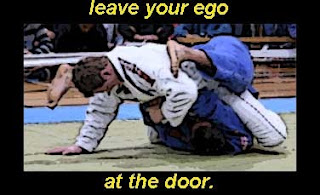
My BJJ instructors, the Machado brothers, have a family credo that begs: ‘leave your ego at the door’. This is something that martial artists can find difficult to do but it is nevertheless a goal worth setting for ourselves. Our ego likes to be right, our ego likes to win and it will squirm and wiggle, plot and plan to avoid having to experience anything otherwise. One of the most corrosive outgrowths of ego is that it will talk us out of doing things where there is a reasonable or high chance of failure. In this way, ego is probably the single biggest hurdle to overcome if we are to experience growth and learning as human beings. Some martial arts environments make it easy for the ego to remain intact, because the lack of serious tests or challenges, ensure that the ego is never really threatened. Some schools are very challenging for the ego; kickboxing or boxing gyms, BJJ or other grappling schools, etc ; in these kinds of places there are few hiding places and the ego is constantly assaulted. This is a good thing; ultimately it allows us to live in state of greater peace and with the sense of confidence that comes with real experience.

What lies around the corner, no one can know. Whether we accept it or not, life is, and always will be, an exploratory journey. As is the case with all exploration, if the unfolding trek doesn’t succeed in killing us, it will almost certainly provide us with instruction. If we want to learn things that others do not know, we need to be willing to do the things that other people do not do.

The martial arts practise, in and of itself, is something that most people are not willing to do; so in some sense, we are already on the path to a kind of excellence that remains out of reach of many people. Extraordinary results are the consequence of extraordinary actions or decisions; and who would settle for anything less? Well, I’ll answer that question for you: nearly everybody! Look around, the world is full of the ordinary, the mundane, disease, unhappiness, suffering; do we really need to contribute more of the same. For myself, the answer is definitely not. I want to live an extraordinary life and this means that I need to do extraordinary things. I approach my martial arts training with this credo in mind and I think they day we begin to settle for the ordinary; then this is the day we should give up our martial arts practise.

Most combative disciplines have evolved under very specific sets of conditions. Some of these disciplines are more or less adaptive than others. In a constantly evolving and changing environment, like the world we live in, it is incumbent upon the martial arts professional to either accept the limitations of what they have to offer or open their minds to further learning. The basic underlying rule of evolution is adapt or perish.

The martial arts are not immune to this universal principle. Each of us has adapted in a greater or lesser degree to the world in which we now live; a world that is very different from the world that existed ten, twenty or thirty years ago. None of us are in denial about the need to drive a car or use a mobile phone for example; but how many martial artists are in denial about the fact that the techniques and strategies that are on offer in the modern-day martial arts landscape are very highly evolved from where they were ten or twenty years ago. The is just so much great material out there and available now; so many effective and innovative training methods; and much of it with a proven track record; can we afford to ignore this fact? I do agree that the world needs some people who are willing to say, collect and preserve old stamps for historical reasons or perhaps out of personal interest; but just don’t try to post any letters with them. I think we need to make distinctions here; distinctions between what we are preserving for arts sake and what we need to practise for effective self-defence in today’s rapidly changing world.

Innovation is naturally driven by necessity and circumstance, and our capacity for creativity seems boundless; but it is when we are cut loose from the confines of familiarity that we can truly tap into our innovative potential. Becoming more innovative is more about familiarizing ourselves with risk, and less about staying with the tried and true.

Ideas spread if they have survival value. In this sense, they are subject to evolutionary forces in a similar way to living things. Good ideas survive and propagate; bad ideas die a natural death. Ideas that other people have about us, also spread and propagate. What ideas these are, depends much on how we go about our work and how we live our lives. Building a solid reputation begins with making small promises and living up to them.
We become more innovative as we let our ego’s go. This takes us back to the first paragraph of this article. The less attached we are to having to win or needing to be right, or be comfortable, or be safe, then the more risks we will take and the more things we discover. It is a process that shouldn’t frighten anyone; there is great joy to be had in discovering things; even if some of these things highlight our shortcomings; perhaps even, especially if they do.
Best wishes
John B Will

Sunday, May 02, 2010

The Game ...


Let me pose a question ...
Would you sign up and volunteer for a game in which there were very few rules, lots of learning to do, a chance of injury early on in the play, but also a chance of huge adventure, becoming a millionaire, and perhaps of even finding the love of your life - but with one huge price tag - and that is this: No-one gets out alive!
Well, you may not have volunteered for it ... but you are definitely in it - the game has an unknown time limit ... and the name of the game is LIFE!
How far into the game you are, nobody knows; maybe you are still playing in the first quarter; maybe you are in the last quarter - maybe you are in the last few moments of overtime. The point is this: No-one gets out alive! That being said; the real point is this ... play hard and love every minute of it; realise that other people are playing too, and many of them are on your team. The game will come to an end ..and it's the playing of it that really counts - because unlike a game of sport, you won't be around to read the scoreboard once the real game is over.
The reason I am writing this blog is because I look around and wonder that most people seem to be playing the game of life as if it were never going to come to an end. I find that to be quite tragic. I do not mean to come across as being pessimistic or morbid - in fact, the very opposite; I want to make a case for wringing every drop of juice out of life that we can.
Every time I hit the mat for training - I am reminded of how ALIVE I am. For me, the struggle and learning that takes place in my BJJ training, connects me more closely to the real nature of the game.
Squeeze the juice my friends .... the game is on ... and no-one gets out alive!
JBW