Tuesday, September 30, 2008

Fear - friend or foe?


Fear – that most primeval of motivations, applies a subtle pressure to the way we live, the way we train and the way we live our lives. As martial artists and fighters, we should study fear, we should know it, learn from it, even embrace it, if we are to fulfil our potential.
Fear is the most powerful of foes and yet can be the most powerful of allies; it is a strange thing that most people live with daily, yet also know little about. It urges, it tethers, it whispers and sometimes it screams; but where does comes from and can it be harnessed?
These are questions that warriors are in the business of answering. The more often we put ourselves ‘on the line’, the closer we come to some level of mastery over our fear. It becomes less a thing that makes us run and more something we can see as an opportunity to learn and grow.
Fear is an old thing; an on-off switch that formed an integral part of our early ancestors hard-wiring. It was the basis of our most primitive survival mechanisms; something that prompted us to run when circumstances required and to fight harder when we had no other alternative. Fear is the fuel that drives the engine that resides in every single one of us; in which direction it drives us depends on circumstances and to some degree, how we have trained ourselves to respond. To harness our fear, it helps to understand what it is. In fact to master any thing, we first need to understand that thing.
The feeling we call fear begins with a release of hormones, the most well understood of which is called adrenaline. Sometimes this release is slow and subtle, giving rise to a gnawing feeling in our stomach. Over time, this kind of non-stop adrenal release can give rise to stress and even impact negatively on our health. At other times it is released in a torrent, causing tunnel vision, time distortion and a screaming desire to run as far and as fast as we can from the stimulus that bought it on. This latter symptom is often referred to as ‘flight or fight’.
The flight or fight response is well known; we perceive a threat, hormones are released into our bloodstream, blood vessels constrict, the heart-rate soars and in a second our body is driven by forces as old as mankind itself. This all makes perfect sense. Our early ancestors relied on this super-charging mechanism to provide them with the strength and focus to survive in times of great and sudden stress. In the simplest of terms, fear made us run faster if we could, or fight with more strength if we couldn’t. It depended more on the circumstances than anything else as to which way we reacted under pressure; and rarely our will power.
The unfortunate reality though, is the fact that although the ‘flight or fight’ response has been integral to our survival throughout our evolution, in many instances we are still governed by it today, even when it no longer serves a useful purpose. The most-subtle example of this is evidenced by the fact that most people do not like to venture too far from their comfort zones. The bottom line here is that we fear the unknown and this in itself, is the biggest hurdle to personal growth that human beings need to overcome. In the past, fear of the unknown probably kept many of our ancestors alive. If they didn’t know the plant they wouldn’t eat the plant; if they weren’t familiar with another tribe, they stayed away for fear of consequence. Now though, these self-same reactions hold people back from trying new foods and making new acquaintances. Old fears can often mean new shackles.
Sometimes though, the ancient hormonal reaction to danger (the adrenal dump) can save our lives. If the threat is ‘real and present’, then the rush of adrenaline can provide us with the focus and strength we need to prevail. Even this though, cannot be taken for granted. For those who havn’t experienced this regularly, the adrenal-response can also paralyse and cripple. Remember, our ancestors lived with these feelings, they were intimately familiar with them but in the course of our own everyday lives, most of us are not used to their effects and can be adversely effected by them. Luckily, a variety of training models exist that can help prepare today’s martial artists for the effects of sudden adrenal dump.
In short, fear can be a friend but it can also be our greatest foe. Pushing our boundaries, extending our comfort zones and taking risks can help acquaint us with fear and in time make it a friend. Understanding that at it’s basis it is just a chemical response to a specific set of circumstances and that we can interpret that response as ‘prime physiological preparation’, will go some of the way toward helping us harness our fear and ultimately prevail.
JBW 2008

Wednesday, September 24, 2008

Secrets of the Shooting the Double


Singles and doubles are the bedrock of good ‘shooting style’ takedown strategy.
Although there are significant differences in the way we should train and execute High Doubles, High Singles, Low Doubles and Low Singles – there are also some commonalities. If we train the following components, we should enjoy an improvement on all of those takedowns:

- The LEVEL CHANGE: developing an ability to quickly and suddenly change levels is fundamental to good leg-shoots. We should always change levels before we step in for the ‘shot’.
- The PENETRATION STEP: Being able to step in strongly and with enough ‘penetration’ is paramount if we want to reduce our chances of being ‘sprawled on’. The angle of flexion in our lead knee should be ‘less’ once the step has been taken, and not greater than the angle we had on the initial level change.
- The LEAN IN: Once our shoulder connects with the opponent, we need to ‘lean’ in and ‘stick’ to him. This ‘stickiness’ will prevent us from experiencing the ‘billiard ball’ effect of knocking him away and into his defence (sprawl). On low doubles especially, the ‘lean in’ allows us to control how hard our knee impacts on the floor/ground; very important for those with ‘older’ knees or for street applications.
-
Although there are a myriad of other details that I have not gone into here, these two things alone can really make or break a single or double leg shot. A lot of students tend to put focus on the ‘finish’ of the takedown, in the same way they tend to focus on the ‘finish’ of an attack – but once again, we will never even have the opportunity of working a ‘finish’ if we don’t work through the process that precedes it. By putting time into practice of the LEVEL CHANGE and the PENETRATION STEP phases of the leg shoots, we will see marked improvements in how many shots we chalk up as ‘wins’.
Happy shooting,
JBW

Thursday, September 18, 2008

Award from Military Unarmed Cell


It was a totally unexpected pleasure to receive a special presentation from Major Travis Faure, head of the Military Unarmed Combat Cell for the Australian Army, at the Championships on the weekend. The presentation comprised of a series of photos taken at the Royal Military College in Canberra, where I have done a lot o work this year. As much of my work for various military and other law enforcement agencies is somewhat ‘under the radar’, I have few momento’s to stick up on my study wall; so this one is much appreciated. (My ‘secret squirrel’ T-shirt collection, on the other hand, is impressive! But unappreciated by my wife who has to find wardrobe space to accommodate them) Major Faure also shared a few thoughts on behalf of the Aussie military; again, unexpected but very much appreciated. I must say that Travis himself was the driving force behind the total revamp that the Aussie military defensive tactics program has undergone over the past two years.
My sincere thanks to the whole team – you know who you are!
JBW

Monday, September 15, 2008

Under the Microscope


Coaches should always remember that they are operating under the microscope. What I mean by that is they should act and behave as if they are being carefully studied and watched – because THEY ARE! If someone in a leadership role comes to the class late, it sends a clear message to everyone ‘it’s OK to be late’. If they slouch against a wall during class it sends a clear message that ‘slouching against the wall during class is OK’. When a coach makes a small promise and fails to keep it – it sends a clear message ‘I am not worthy of your trust’.
I am often amazed at the behaviour of people in leadership and coaching roles. I doubt they are aware of the messages they are sending and how many people are reading those messages. I am even more amazed when I see people in leadership roles behaving one way but expecting their students to behave in an other; such behaviour is immature and unbecoming of a leader.
Many of the people that read this blog are instructors and coaches themselves. I urge those of you who have those roles to remember that you can only expect others to behave in the ways that you behave. How you act – you can expect your students to act. How you dress, behave, speak and carry yourself in class – will set the tone for how everyone else dresses, behaves, speaks and carries themselves in class. When you make a small promise – keep it. Earn trust. The culture you want to create in your school – starts with YOU!
Best wishes,
JBW

The Convergence


What a weekend! With 280 competitors converging from Australia over, New Zealand, Singapore and Malaysia; this was the most successful competition we have ever had; not only in terms of numbers, but in terms of efficiency, smooth runnig, finishing by 5pm, very few injuries, exceptional comraderie, great seminars the day after for the school-owners with Frank Monea delivering some inspiring ideas on professional school culture and with Rigan Machado teaching two seminars in Melbourne, comprised of techniques from his 'private stash'.
Another HUGE highlight of the day was the pleasure I had in being able to award three new Black Belts their special rank. Steve Perceval - Tony Morris & David Hart will forever remember the date of September 13th! Congratualtions to all of you. Every one very, very well deserved!
I have been inundated with positive feedback and thanks from many who attended on the weekend. I am replying to each and everyone. But my thanks in return to everyone who helped make the event what it was; referees especially, but competitors and spectators alike - everyone played their part.
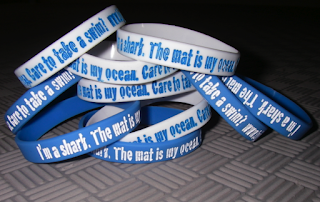
An unexpected a huge hit - were the "I'M A SHARK. THE MAT IS MY OCEAN. CARE TO TAKE A SWIM?" wristbands. I had a bunch of them produced for the competitors but we sold heaps to spectators on the day. Several coaches bought a stack of them to take back as 'give-ways' at their respective schools. What I have left over are available in the shop on this website - in packs of ten. Enjoy!
Best wishes everyone - safe travels back to your respective schools, towns, countries. I look forward to an even bigger and more special event next year. Keep the second weekend in September free!
JBW

Thursday, September 11, 2008

Countdown ...


Everything is good to go for this weekend's championships.
Rigan Machado is on a plane and on his way to Melbourne - as are many competitors from Australia-wide, New Zealand, Singapore and Malaysia. 270 plus competitors will make this day a huge success. The trophies are the best we have done to date - and the prize packs for placegetters will astound! More and more sponsors are coming on board and their generosity and patronage is very much appreciated.
See you all there.
JBW

Monday, September 08, 2008

My transparent coaching model


Most years I have the pleasure of teaching about 100 seminars throughout Australasia, the USA and the UK. Though it’s hard being on the road, living out of a suitcase and being away from my family, it is very rewarding work. I get to meet great people and have the chance to further refine and hone my teaching skills. Each and every time I do a seminar, it is a unique experience. Not only do I tailor the seminar to the client (making every seminar different) I am continually trying out new ways of saying old things, new ways of training and drilling techniques and concepts, a new ways of breaking things down and imparting them to others.
I am pretty much booked solid through the year; and am trying to keep my visits to the USA and to Europe down to once a year only, even though I receive regular invites. Work with the military and some other policing organizations has filled out my calendar to the very edges but I am doing my best to maintain my regular circuit with those hard-core BJJ afficionadoes around Australia and New Zealand.
People often ask me how our organization has grown so dynamically over the last decade – the short answer – my seminar circuit. People need to put in the time, they need to practice – but they need to practice the right things in the right way and with the right mindset. When teaching at other people’s schools, I do my best to instil new and interesting coaching ideas as well. In fact, of late (the last few years) I use a transparent coaching model whereby I tell the students WHY I teach the way I do. I explain the process of TEACHING and COACHING as well as the process of DOING. Many people in my classes have gone on to coaching/teaching roles themselves – and knowing this is the case, I use the opportunity, most time I conduct seminars, to add COACHING VALUE to the lesson.
I have found that by employing my transparent coaching model, most of the students present gain a better understanding of techniques and processes I am trying to deliver. I seem to get great feedback from coaches and students alike when I use this ‘train the trainer’ approach to my teaching style.
It does ‘expose’ me to some degree – as like Penn and Teller, I always try to show my students the ‘trick’ to my coaching methods – but I really think it is appreciated. The results certainly speak for themselves – and as I am so very ‘outcome oriented’ – this suits me down to the ground. No Pun intended.
I hope to see some of you on my next circuit.
Best wishes,
JBW

Sunday, September 07, 2008

Surrounded


Having been dropped off by friend Gregg Hooper in one of the most remote parts of the Kimberleys in the North-west of Australia - I enjoyed six days of wilderness adventure.
My first day started with a bang - I had the luxury of toting in a couple of good steaks for that first night - but real wilderness is no place for the unobservant. I walked down to the pool to get some water for cooking , taking careful note of the large saltwater croc that was eyeing me suspiciously from thirty metres away, when a huge sea-eagle swept in from behind me and snatched up my cryo-packed steaks from the rock just three metres behind me. After delivering a few harsh words to the eagle - I noticed the croc had quietly edged in to within fifteen metres of the shore, so I quickly got my water and moved back up to my tent uirther up on the small sandy beach. Sitting down, still watching the croc, I began to cook some noodles (lucky I had plenty of those) when I heard a noise behind me; looking around, a huge brown snake slithered past, making me jump up and out of my seat.
Surrounded - crocs in the front, snakes behind and eagles above. Can't a guy get some rest when he needs it?
Five similar days followed - before my chopper flying mate came to grab me. Back home now and preparing for the big comp this weekend. Times it just right to get home for fathers day. Nice co-incidence.
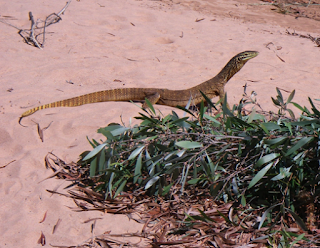
Here are a few pics of some wild places and wild things that live there.
Best wishes all,
JBW